
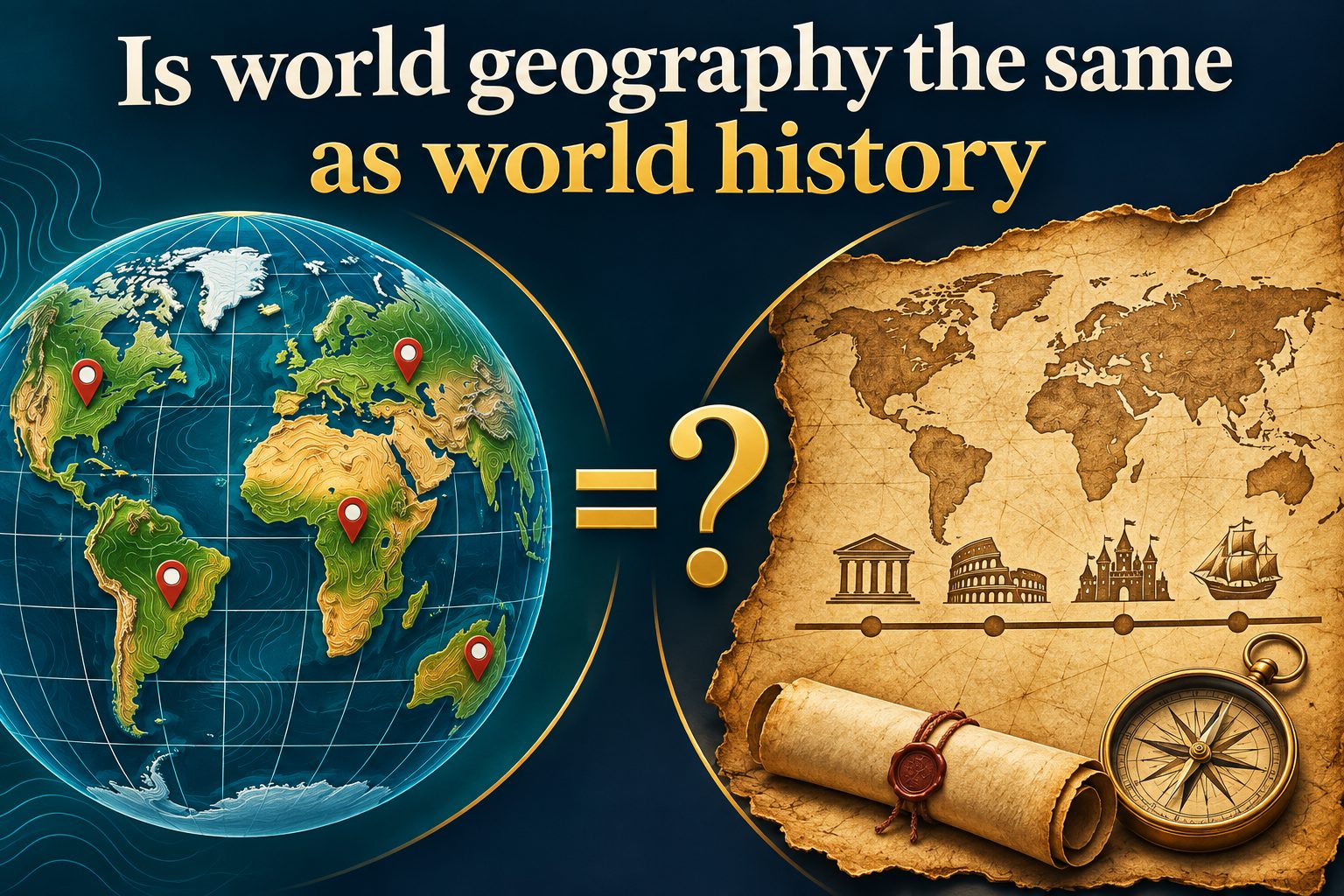
Is world geography the same as world history? No. Although these subjects are closely connected, they examine different parts of human knowledge. World geography focuses on places, environments, landforms, climate, populations, resources, and the relationships between people and their surroundings. World history focuses on events, societies, leaders, ideas, conflicts, inventions, and changes over time. Geography asks where and why something happens in a particular location, while history asks what happened, when it happened, and how it affected later generations. Studying both subjects together gives a fuller picture of the world because physical location often influences historical events, and historical decisions frequently change geographic patterns. This article explains the meaning, differences, similarities, benefits, examples, study methods, common mistakes, practical uses, and frequently asked questions about world geography and world history.
The Meaning Of World Geography
World geography is the study of Earth’s physical features, human populations, places, and spatial relationships. It examines continents, oceans, rivers, mountains, climates, cities, borders, languages, cultures, economies, and patterns of settlement. Geography is not simply memorizing locations on a map. It also asks why people live in certain areas, how environments affect societies, and how human activity changes the planet.
1. Physical Geography
Physical geography examines natural features and processes. Mountains, deserts, rivers, oceans, glaciers, earthquakes, volcanoes, rainfall, and climate zones all belong to this field. Physical geography helps explain why some regions are fertile, why certain places experience hurricanes, and why communities develop differently in coastal, tropical, mountainous, or arid environments.
2. Human Geography
Human geography focuses on people and the spaces they occupy. It includes population growth, migration, urban development, religion, language, culture, political boundaries, and economic activity. For example, human geography can explain why major cities grow near rivers, ports, or transportation routes and why populations move when jobs, safety, or resources become limited.
3. Cultural Geography
Cultural geography studies how culture is distributed across the world. Languages, traditions, food, clothing, architecture, music, and religious practices can vary from one region to another. It also explores how cultures spread, mix, adapt, and sometimes disappear because of migration, trade, conquest, technology, or globalization.
4. Political Geography
Political geography examines countries, territories, borders, governments, and power relationships between places. A border may follow a river, mountain range, colonial decision, or military agreement. Political geography helps explain why some borders are disputed and why control over particular regions can lead to tension between neighboring states.
5. Economic Geography
Economic geography explores how resources, industries, trade, transportation, and labor are distributed. Oil fields, farmland, mineral deposits, ports, factories, and technology centers influence national economies. This field helps explain why certain regions become wealthy industrial centers while others depend heavily on agriculture, mining, tourism, or international aid.
6. Environmental Geography
Environmental geography studies the relationship between people and nature. It examines pollution, deforestation, climate change, water shortages, conservation, agriculture, and sustainable development. This perspective shows that geographic conditions are not fixed. Human choices can reshape landscapes, damage ecosystems, or create better ways to manage natural resources.
The Meaning Of World History
World history is the study of human societies and major developments across different regions and periods. It includes ancient civilizations, migrations, religions, political systems, wars, empires, economic changes, scientific discoveries, social movements, and cultural achievements. Unlike geography, history is primarily organized around time and change.
1. Historical Events
History examines events such as the rise of civilizations, the development of trade routes, the spread of religions, revolutions, wars, independence movements, and technological changes. Historians do not simply list events. They investigate causes, consequences, evidence, perspectives, and connections between developments in different regions.
2. Historical People
Leaders, scholars, inventors, activists, artists, soldiers, merchants, and ordinary citizens all influence history. Studying individuals can make large historical changes easier to understand, but responsible history also considers social groups and institutions rather than focusing only on famous people.
3. Historical Periods
World history is often divided into periods such as prehistory, antiquity, the Middle Ages, the early modern period, and the modern era. These divisions help organize information, although boundaries differ depending on the region. A period that represents major change in Europe may not describe the same transition in Africa, Asia, or the Americas.
4. Causes And Consequences
A major purpose of history is to examine why events happened and what followed. A revolution may result from economic inequality, political frustration, social division, or foreign influence. Its consequences may include new laws, migration, violence, independence, or changes in international power.
5. Primary Evidence
Historians use written records, oral traditions, letters, government documents, objects, buildings, artwork, maps, tools, and archaeological remains. Evidence may be incomplete or biased, so historians compare sources and consider who created them, why they were created, and which voices may be missing.
6. Change Over Time
History explains how societies transform. Political systems, technologies, borders, economies, and cultural practices can change gradually or suddenly. Studying these changes helps people recognize patterns, question oversimplified explanations, and understand that modern conditions developed through many earlier decisions.
The Main Difference Between Geography And History
The clearest difference is that geography emphasizes space, while history emphasizes time. Geography asks where something is located and how location affects it. History asks what happened, when it happened, why it happened, and what effects it produced. These subjects overlap, but their main questions and methods are different.
1. Space And Location
Geography is concerned with location and distribution. A geographer may study where populations are concentrated, where deserts occur, or how cities spread. Maps, satellite images, geographic information systems, and field observations are common tools for examining spatial patterns.
2. Time And Sequence
History is concerned with chronology and development. A historian may study the sequence of political decisions that caused a war or the stages through which an empire expanded and declined. Timelines, archives, oral histories, and written records help organize historical change.
3. Natural Conditions
Geography often investigates natural conditions such as climate, terrain, soil, water, and ecosystems. These conditions can influence agriculture, transportation, settlement, and health. History may use those conditions to explain why a society made certain choices or faced particular challenges.
4. Human Decisions
History pays close attention to human decisions and their consequences. Leaders, governments, communities, and social movements make choices that shape the future. Geography also studies human decisions, but it focuses more on how those choices affect places, populations, and spatial relationships.
5. Research Tools
Geographers commonly use maps, charts, fieldwork, population data, spatial analysis, and environmental measurements. Historians commonly use documents, artifacts, testimony, inscriptions, newspapers, and archives. Both fields require careful interpretation and evaluation of evidence.
6. Type Of Explanation
Geography often explains patterns, relationships, and distributions. History often explains sequences, causes, turning points, and consequences. For example, geography may explain why a city developed beside a river, while history may explain how political decisions transformed that city over several centuries.
How Geography And History Work Together
Geography and history are separate subjects, but neither can always be fully understood alone. Historical events happen in real places, and those places influence what is possible. At the same time, historical choices reshape borders, landscapes, cities, populations, and economies.
1. Rivers And Early Civilizations
Many early civilizations developed near rivers because rivers provided water, fertile soil, transportation, and food. The Nile, Tigris, Euphrates, Indus, and Yellow River supported large settlements. Geography explains the advantages of these locations, while history explains how governments, social classes, writing systems, and belief systems developed there.
2. Mountains And Political Boundaries
Mountain ranges can separate communities, slow armies, and create distinct cultural regions. The Himalayas, Alps, Andes, and Caucasus have influenced migration, trade, defense, and political boundaries. History shows how people crossed or controlled these barriers, while geography explains why the barriers mattered.
3. Oceans And Exploration
Oceans connected distant societies through trade, migration, exploration, and conquest. Maritime routes helped spread goods, technologies, religions, and diseases. Geography explains the location of ports and sea routes, while history examines the consequences of exploration, colonialism, and global exchange.
4. Climate And Agriculture
Climate affects what crops can grow and how communities organize food production. Droughts, floods, cold periods, and changing rainfall patterns have influenced migration and political stability. Historical research helps show how societies responded to environmental pressures through irrigation, storage, trade, adaptation, or conflict.
5. Borders And Conflict
Many conflicts involve control of land, resources, strategic routes, or culturally important places. Geography identifies the location and value of a disputed area. History explains how borders were created, changed, challenged, or imposed by treaties, wars, colonial administration, or independence movements.
6. Cities And Industrialization
Cities often grow because of their geographic advantages, including ports, rivers, fertile plains, mineral deposits, or transportation networks. History explains how industrialization, migration, government policy, and technological change transformed those cities. Together, the subjects reveal both the physical setting and the human process of urban growth.
Why Studying Both Subjects Matters
Learning geography and history together improves knowledge of current events, culture, politics, economics, and global relationships. Students gain more than isolated facts because they learn to connect location, environment, people, and time.
Geography provides context. Knowing where a country is located, which neighbors surround it, and what resources it possesses can make its political and economic decisions easier to understand.
History provides explanation. A modern border, conflict, alliance, or cultural tradition often has roots in earlier events. Historical knowledge prevents people from treating present conditions as if they appeared suddenly.
Both subjects develop critical thinking. Students compare evidence, recognize patterns, identify cause and effect, and question simple explanations. They learn that one event may have several causes and that different groups may experience the same development differently.
These subjects also support cultural awareness. Geography introduces regional diversity, while history explains how cultures formed and interacted. Together, they can encourage respect for different traditions without pretending that every historical relationship was peaceful or equal.
Finally, geography and history help people become informed citizens. Understanding migration, climate risks, economic interdependence, international disputes, and cultural change requires knowledge of both places and past events.
Examples Of Geography And History Working Together
Examples make the relationship between the two subjects clearer. Each case shows that location and time provide different but connected parts of the explanation.
1. The Silk Roads
The Silk Roads were networks of trade routes connecting parts of Asia, Europe, and Africa. Geography explains the importance of deserts, mountain passes, oases, and caravan cities. History explains how merchants, empires, religions, technologies, and diseases moved along those routes over many centuries.
2. The Nile Valley
The Nile’s regular flooding created fertile agricultural land in an otherwise dry region. Geography explains why settlements concentrated near the river. History explains how centralized government, monumental architecture, writing, taxation, and religious traditions developed in ancient Egypt.
3. The Atlantic Slave Trade
The Atlantic slave trade involved forced movement of millions of Africans across the Atlantic. Geography helps identify the ports, plantations, ocean routes, and regions involved. History reveals the political systems, economic demands, racial ideologies, resistance, and long-term consequences that shaped this tragedy.
4. Industrial Britain
Britain’s coal deposits, navigable rivers, coastline, and access to trade routes supported industrial growth. Geography identifies the physical advantages. History explains how inventions, factories, labor systems, urbanization, imperial expansion, and social movements transformed British society.
5. The Partition Of India
The partition created new political borders and caused large-scale migration and violence. Geography shows the location of the new states, transportation routes, rivers, and contested regions. History explains the end of colonial rule, political negotiations, communal tensions, and the decisions that produced partition.
6. The Panama Canal
The Panama Canal connects the Atlantic and Pacific Oceans through a narrow land bridge. Geography explains why this location was strategically valuable. History explains the construction process, international involvement, health challenges, political agreements, and the canal’s effect on global shipping.
A Practical Process For Studying Geography And History
Students can combine both subjects through a simple process that moves from place to event and then to consequences.
1. Locate The Region
Begin with a physical and political map. Identify neighboring countries, rivers, mountains, coastlines, climate zones, and major cities. This creates a spatial framework before you begin memorizing dates or names.
2. Establish The Time Period
Create a basic timeline showing the major period under study. Note important rulers, migrations, wars, inventions, treaties, and social changes. A timeline prevents events from becoming disconnected facts.
3. Identify Geographic Conditions
Ask how terrain, climate, resources, waterways, and distance affected settlement and movement. These factors may explain why a society developed near a specific location or why a route became economically important.
4. Study People And Institutions
Examine governments, communities, religions, economic groups, and leaders. Consider who had power, who lacked power, and how different groups experienced the same events.
5. Connect Causes And Effects
Separate immediate causes from deeper conditions. Then identify short-term and long-term consequences. This approach creates a more accurate explanation than blaming one person or one event for a complex development.
6. Compare Different Regions
Look for similarities and differences between places. Comparing two river civilizations, trading networks, or independence movements can reveal how different environments and political systems shaped outcomes.
7. Review With Maps And Timelines
Finish by reviewing both the map and timeline together. Ask whether the location helps explain the sequence of events and whether historical developments changed the geographic pattern. This final connection strengthens long-term memory.
Common Mistakes When Comparing Geography And History
Many learners confuse geography and history because the subjects often appear in the same classes. Avoiding a few common mistakes can make studying much more effective.
1. Treating Geography As Memorization
Memorizing capitals and borders is useful, but geography involves much more than naming locations. Ask why populations, industries, and cities are distributed in particular ways. Focus on patterns and relationships rather than isolated facts.
2. Treating History As A Date List
Dates help organize events, but history requires interpretation. Study causes, evidence, perspectives, and consequences. A timeline should support understanding rather than replace it.
3. Ignoring Physical Geography
Historical explanations can become incomplete when they ignore rivers, mountains, climate, disease environments, and resources. Physical conditions do not determine everything, but they can create opportunities and limitations that influence human choices.
4. Assuming Geography Determines Everything
The opposite mistake is believing that the environment completely controls society. People adapt, invent, cooperate, and make political choices. Geography creates conditions, but it does not remove human agency or explain every historical outcome.
5. Using Modern Borders In Ancient History
Modern countries did not always exist in their current form. Applying today’s borders to ancient societies can create confusion. Use maps that match the historical period and remember that political boundaries change over time.
6. Accepting One Simple Cause
Major events usually result from several connected causes. Economic pressure, political conflict, environmental conditions, social divisions, and individual decisions may all matter. Look for relationships rather than a single explanation.
Best Practices For Learning Both Subjects
A few practical habits can improve accuracy, memory, and depth when studying world geography and world history together.
1. Use A Map With Every Historical Topic
Whenever you study an empire, war, migration, or trade network, locate it geographically. Seeing distance, terrain, and neighboring regions often clarifies information that seems confusing in a written summary.
2. Build Combined Timelines
Create timelines that include political, technological, environmental, and cultural developments. This helps reveal connections, such as how new transportation technology affected migration or how climate stress contributed to political instability.
3. Ask Where, When, And Why
These three questions provide a useful framework. Where directs attention to geography, when directs attention to history, and why encourages analysis. Together they turn passive reading into active investigation.
4. Compare Primary Sources And Maps
A written account may describe an event from one perspective, while a map reveals movement, territory, or distribution. Comparing different types of evidence helps identify bias and creates a fuller explanation.
5. Study Ordinary People
Do not focus only on kings, generals, and presidents. Farmers, workers, migrants, families, merchants, and local communities also shape historical and geographic patterns. Their experiences often reveal how large changes affected daily life.
6. Explain Connections In Your Own Words
After studying a topic, write a short explanation linking location and time. For example, describe how a river supported settlement and how later political institutions developed around that settlement. Personal explanation improves retention.
Practical Uses Of Geography And History
Knowledge of both subjects has value beyond school examinations. It supports everyday decisions, professional work, and responsible participation in society.
1. Understanding Current Affairs
News about conflict, migration, elections, trade, or climate often depends on geographic and historical context. Knowing the location of a region and the history of its relationships can prevent misunderstandings.
2. Planning Travel
Travelers benefit from understanding landscapes, climate, cultural traditions, historical sites, transportation routes, and political boundaries. This knowledge supports safer, more respectful, and more meaningful travel experiences.
3. Working In International Business
Businesses operating across borders need awareness of markets, resources, infrastructure, regulations, cultural expectations, and historical relationships. Geography identifies practical opportunities, while history helps explain trust, competition, and regional sensitivities.
4. Teaching And Research
Educators and researchers use both subjects to explain complex issues. Combining maps, documents, statistics, oral histories, and environmental evidence creates lessons and studies that are more balanced and engaging.
5. Making Civic Decisions
Voters and community members encounter questions about housing, transportation, immigration, environmental policy, public services, and international cooperation. Geography and history help people evaluate these questions with greater awareness.
6. Protecting Cultural Heritage
Historic buildings, archaeological sites, traditional landscapes, and cultural practices are connected to specific places. Understanding their geographic setting and historical meaning supports responsible preservation and community planning.
Frequently Asked Questions
1. Is World Geography The Same As World History?
No. World geography studies places, environments, populations, resources, and spatial relationships. World history studies human events, societies, political changes, cultural developments, and events over time. They overlap because historical events occur in geographic settings, but geography focuses mainly on space while history focuses mainly on time and change.
2. Which Subject Is Easier, Geography Or History?
The answer depends on the learner. Geography may feel easier for students who enjoy maps, patterns, statistics, and visual information. History may feel easier for students who enjoy stories, documents, timelines, and explanations of human behavior. Both subjects require memorization, interpretation, comparison, and critical thinking.
3. Why Are Geography And History Often Studied Together?
They are studied together because location influences historical events, and history changes places. Rivers, mountains, resources, and trade routes can affect settlement and conflict. In turn, wars, migrations, governments, and economic systems can change borders, cities, landscapes, and population patterns.
4. Can You Study History Without Geography?
You can study historical events without detailed geographic knowledge, but your understanding may be incomplete. Geography explains distances, terrain, climate, resources, routes, and strategic locations. Without that context, it can be difficult to understand why people moved, why conflicts occurred, or why certain settlements became important.
5. What Is The Best Way To Learn Both Subjects?
Use maps, timelines, short summaries, primary sources, and comparison charts together. Start by locating a region, then establish the time period, identify geographic conditions, study the people and institutions involved, and connect causes with consequences. Reviewing the map and timeline together is especially effective.
6. Do Geography And History Help With Modern Problems?
Yes. Modern issues such as climate change, migration, international conflict, urban growth, resource shortages, and economic inequality have both geographic and historical dimensions. Geography shows where problems occur and how they are distributed, while history explains how earlier decisions and relationships contributed to present conditions.
Conclusion
World geography and world history are not the same subject, but they are deeply connected. Geography focuses on space, place, environment, population, and distribution, while history focuses on time, events, people, causes, and consequences. Geography helps explain the setting in which societies develop, and history explains how those societies change through decisions, conflicts, cooperation, and adaptation.
Studying both subjects together creates a more complete view of the world. Maps provide location, timelines provide sequence, and careful analysis connects the two. Whether you are preparing for an exam, researching a country, following current events, or trying to understand global cultures, combining geographic and historical thinking leads to clearer and more balanced conclusions.
Discussion